
Proteins Modeling
We work at the modeling of proteins, to investigate the relationship between structure and function. We use standard and advanced sampling statistical mechanics methods. We mainly focus on membrane channels (nicotinic receptor, cyclic nucleotide–gated ion channel, glucose transporter). We also study the aggregation of proteins and other macromolecules (amyloid-beta aggregates, nucleosome aggregates).
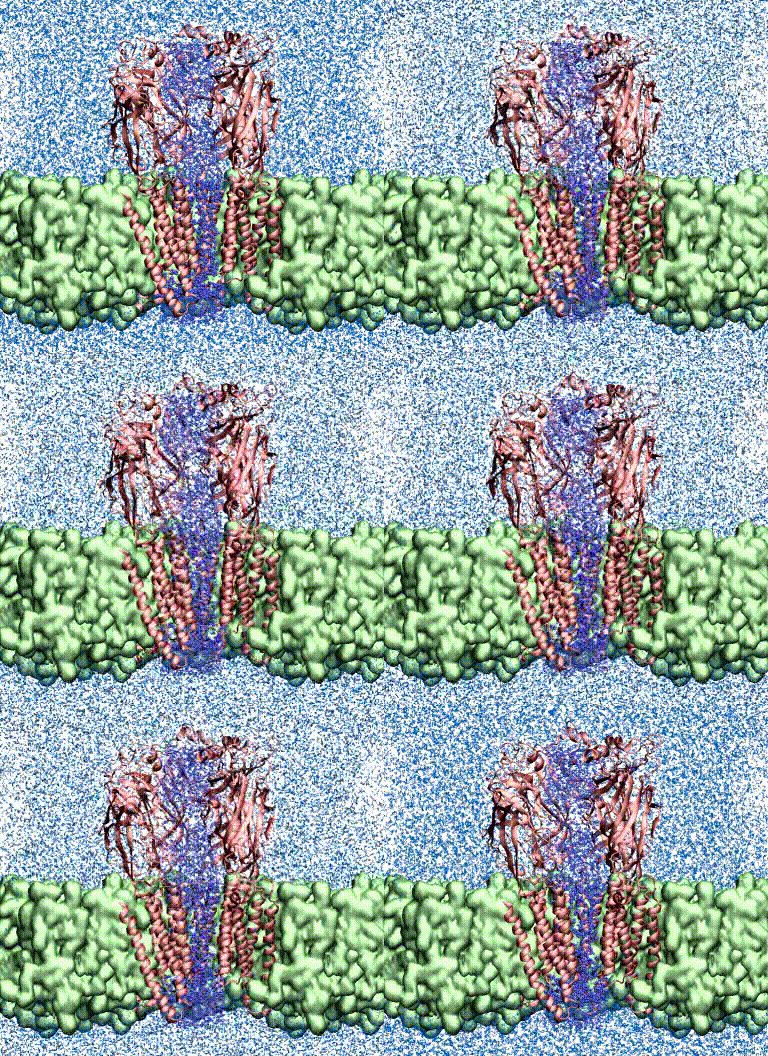
Structural and Functional Characterization of Caenorhabditis elegans Cyclic GMP-activated Channel TAX-4 via Molecular Dynamics Simulations”, Eur. Biophys. J. ( 2025).
“Evolution of Large Aβ16-22 Aggregates at Atomic Details and Potential of Mean force Associated to Peptide Unbinding and Fragmentation Events”, Proteins (2023). doi: 10.1002/prot.26500
“Computational methods and theory for ion channel research”, Advances in Physics: X 7, 2080587 (2022).
“Multiscale Hybrid Modeling of Proteins in Solvent: SARS-CoV2 Spike Protein as test case for Lattice Boltzmann – All Atom Molecular Dynamics Coupling”, Communications in Computational Physics (2022).
“In silico conformational features of botulinum toxins A1 and E1 according to intraluminal acidification”, Toxins (2022).
“Closed-locked and apo-resting state structures of the human α7 nicotinic receptor: a computational study”, J Chem Inf Model 58, 2278 (2018).
“A possible desensitized state conformation of the human α7 nicotinic receptor: a molecular dynamics study”, Biophys. Chem. 229, 99-109 (2017).
“A structural model of the human α7 nicotinic receptor in an open conformation”, Plos One 10 (7), e0133011 (2015).
RNA Modeling
We work at the modeling of RNA – proteins interaction. In particular, we investigate the role of secondary and tertiary structure of long non coding RNAs in their interaction with proteins.
“Assessment of tools for RNA secondary structure prediction and extraction: a final-user perspective”, Journal of Biomolecular Structure & Dynamics (2022).
“Hepatitis B protein HBx binds the DLEU2 lncRNA to sustain cccDNA and host cancer-related gene transcription”, Gut (2020).
Collaborators: G. Cottone, M. Lauricella, F. Sterpone, F. Guerrieri, L. Tesei, M. Ballarino, M.A.G. Matarrese
People
Letizia Chiodo, Nicole Luchetti
Projects